7 Signs Your Lake of the Ozarks Deck May Need to Be Replaced

An aging deck does not always need to be completely rebuilt. A loose board, damaged railing section, or isolated problem may be repairable. But when deterioration reaches the framing, support system, connections, or several areas at once, continued repairs may no longer make sense.
Knowing the signs a deck needs replacing can help Lake of the Ozarks homeowners address problems before planning another season of cookouts, family gatherings, and weekends outside.
Pay particular attention to soft or rotting wood, movement underfoot, unstable railings, deteriorating supports, damaged connections, recurring repairs, and widespread aging. These conditions do not automatically prove that a deck is unsafe or must be replaced, but they are good reasons to have the structure professionally evaluated.
Here are seven warning signs worth taking seriously.
1. You Find Soft, Rotted, or Deteriorating Wood
Visible rot is one of the clearest reasons to take a closer look at an older wood deck.
Check more than the deck boards. The surface may appear acceptable while structural wood underneath is deteriorating.
Areas worth examining include:
- Posts and beams
- Joists
- Stair stringers
- Areas around fasteners
- Connections near the house
- Wood where moisture tends to collect
- Sections beneath planters or furniture
Wood decay matters because replacing surface boards does not correct deterioration in the structural frame.
Lakefront conditions make moisture management particularly important. Lakeview Steel Decking specifically designs projects around the moisture, weather, and elevation conditions common throughout Lake of the Ozarks.
If deterioration appears widespread rather than isolated, it may be time to compare the cost and value of continued repairs against a complete replacement.
2. Your Deck Feels Bouncy, Uneven, or Unstable
A deck should feel solid when you walk across it.
Some movement can occur depending on the design, but noticeable bouncing, sagging, shifting, or new uneven areas deserve attention.
The problem may involve individual boards, joists, beams, supports, connections, or another part of the structure. It is impossible to diagnose the cause based on movement alone.
That is why the important step is not guessing what is wrong—it is having the structure evaluated.
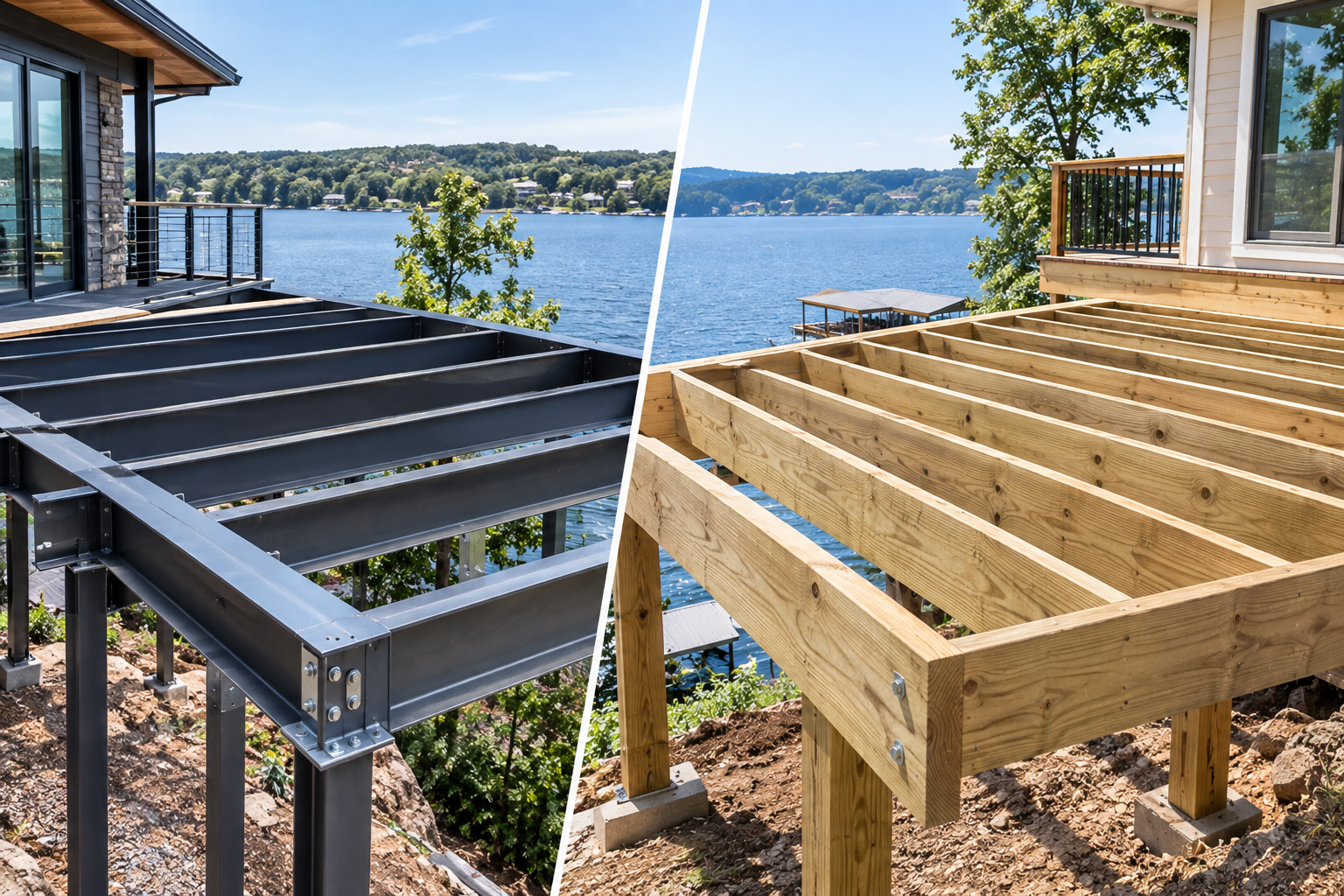
Steel framing can be worth discussing when replacing an aging wood structure because steel does not experience the moisture-related warping, twisting, or shrinking associated with wood. Lakeview Steel Decking specializes in replacing older wood-framed decks with steel-framed systems paired with composite decking.
3. Railings or Stairs Have Become Loose
Railings and stairs are more than design features. They are critical parts of how people safely move through and use an elevated outdoor space.
Watch for:
- Railing posts that move when pushed
- Loose sections or connections
- Wobbly stair rails
- Deteriorating stair treads
- Soft wood around railing connections
- Stairs that feel unstable or uneven
A single loose component may be repairable.
Multiple problems can point toward broader deterioration, particularly when railings or stairs are attached to aging wood framing.
Do not rely on appearance alone. A railing can look acceptable while the material supporting its connections has weakened.
4. Connections Between the Deck and Home Look Questionable
For attached decks, the connection to the house deserves particular attention.
The American Wood Council notes that failure of improperly constructed ledger connections has been a major cause of deck collapses. Its guidance emphasizes positive connections rather than relying on nails alone for structural attachment.
Homeowners do not need to become structural experts, and this is not an area where guessing is advisable.
If you see loose hardware, deterioration around the ledger area, significant corrosion, gaps, water damage, or connections that simply look questionable, arrange a professional evaluation.
A qualified professional can determine whether the issue is isolated, repairable, or part of a larger structural problem.
5. Repairs Have Become a Regular Expense
How often are you fixing the same deck?
One replacement board is routine maintenance. Repeatedly replacing boards, tightening railings, repairing stairs, correcting sagging areas, or addressing new deterioration every season is different.
At some point, homeowners should ask whether they are preserving a good structure or continually spending money on one nearing the end of its useful service life.
This is especially relevant if you are considering installing premium composite decking over an older frame.
Before investing heavily in the visible surface, make sure the underlying structure deserves that investment.
Lakeview Steel Decking uses steel framing as the foundation for many of its replacement projects because it provides a stable structure beneath premium composite decking.
6. Your Deck No Longer Fits How You Use the Property
Replacement decisions are not always driven by structural deterioration.
Sometimes an older deck simply does not work for the way a property is used today.
Maybe the deck is too small for entertaining. Perhaps stairs interrupt the best furniture arrangement, the railing blocks your lake view, or there is unused space underneath an elevated structure.
A replacement creates an opportunity to reconsider the entire outdoor area instead of recreating the same layout.
For example, homeowners may want to incorporate:
- A larger entertaining area
- Better-positioned stairs
- Modern railing
- Integrated lighting
- A pergola for shade
- Composite decking
- Under-deck drainage for usable space below
- Multiple levels for sloped lakefront properties
Lakeview Steel Decking offers these features as part of complete outdoor living projects, allowing the structure and finished elements to be planned together.
7. Several Warning Signs Are Appearing at Once
One isolated issue does not necessarily mean you need a new deck.
Several issues appearing together tell a different story.
For example, a deck with deteriorating posts, loose railings, warped framing, aging stairs, and recurring surface repairs deserves a more comprehensive assessment than a deck with one damaged board.
The age of a deck alone also cannot tell you whether replacement is necessary. Construction quality, framing material, maintenance, exposure, drainage, and previous repairs all affect how a structure performs over time.
Instead of relying on age alone, consider the overall condition of the entire system.
Repair or Replace: How Do You Decide?
Start with the structure.
If the framing and major connections remain sound and the problems are limited, targeted repairs or resurfacing may be practical. Lakeview Steel Decking handles smaller projects such as railing replacements, stair systems, and deck resurfacing in addition to complete deck construction.
If deterioration is widespread or the existing design no longer works, replacement can provide an opportunity to address both structural concerns and usability at the same time.
This is also when steel framing becomes worth considering.
Rather than rebuilding an aging wood structure with the same approach, homeowners can explore steel framing combined with composite decking for a structure designed around stability, lower maintenance, and long-term performance.
Frequently Asked Questions About Deck Replacement
How do I know if my deck needs replacing?
Common warning signs include widespread wood rot, unstable framing, loose railings or stairs, deteriorating structural connections, sagging areas, and repeated repairs. A professional evaluation is the best way to determine whether repair or replacement is appropriate.
Can I replace the deck boards without replacing the frame?
Sometimes. If the existing frame is structurally sound and suitable for the new decking system, resurfacing may be possible. The framing should be evaluated before installing new decking over an older structure.
Can an old wood deck be replaced with steel framing?
Yes. Lakeview Steel Decking regularly works on projects involving removal of aging wood-framed decks and replacement with steel framing, composite decking, and modern railing systems.
Do I need a permit to replace my deck?
Permit requirements can vary depending on the location, project size, and scope. Lakeview Steel Decking notes that many deck projects require permits and helps homeowners navigate applicable requirements during project planning.
Where does Lakeview Steel Decking offer deck replacement?
Lakeview Steel Decking serves Lake Ozark, Osage Beach, Four Seasons, Camdenton, Rocky Mount, Greenview, Sunrise Beach, Gravois Mills, and surrounding Lake of the Ozarks communities.
Concerned About Your Existing Deck? Start With an Evaluation
Do not wait for an obvious failure before paying attention to an aging deck.
Soft wood, unstable railings, recurring repairs, questionable connections, movement, and widespread deterioration are all reasons to take a closer look.
Replacement may also be an opportunity to build something better suited to your property—whether that means steel framing, composite decking, clearer lake views, better stairs, integrated lighting, or additional usable outdoor space.
Lakeview Steel Decking brings 30+ years of building experience to deck projects throughout Lake of the Ozarks and specializes in durable steel-framed outdoor living systems.
Think your deck may be ready for replacement?
Contact Lakeview Steel Decking, or you can also call (573) 557-4330, Monday through Friday, 8:00 a.m.–4:00 p.m.
Recent Posts